Java Array: Sum of Elements in Even-Odd Positions
Arrays are fundamental data structures, and mastering their manipulation opens avenues for efficient programming. In this blog post, we’ll explore the Java programmatic approach to finding the sum of elements in even-odd positions within an array. Follow along for a comprehensive guide, practical coding examples, and insights into effective array traversal.
Understanding the Challenge:
Calculating the sum of elements in even and odd positions involves iterating through an array and selectively adding elements based on their index.
As we know that array index starts from Zero (0) means their 1st element position is the 0 and 5th element position is the 4 and so on.
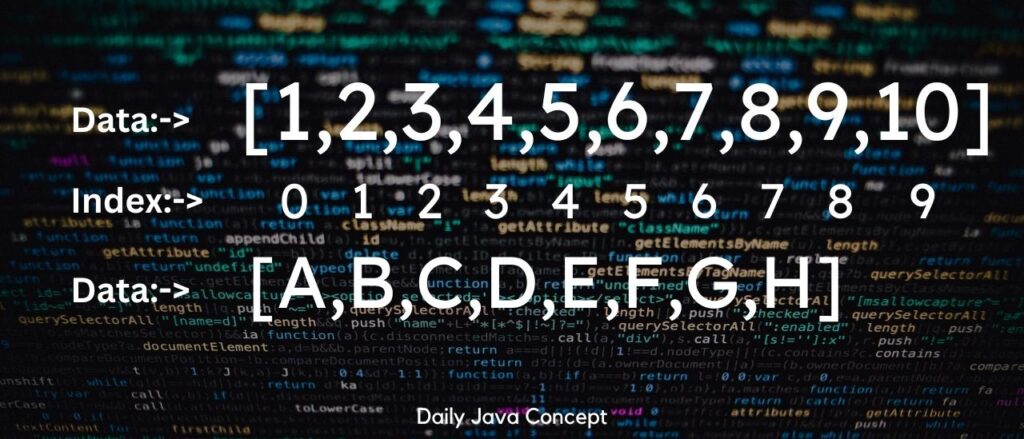
Before going to the program, you have to know that how to find even and odd numbers: Number is Even or Odd without modulus? after finding the position of the element based on odd/even you can sum the elements. Below program follows the modulus operator to find the even and odd numbers. this is also one of the learning.
Sum of Elements in Even-Odd Positions
public class EvenOddPositionSum {
    public static void main(String[] args) {
        // Declare and initialize an array
        int[] array = {1, 2, 3, 4, 5, 6, 7, 8, 9, 10};

        // Calculate sum of elements in even and odd positions
        int evenPositionSum = 0;
        int oddPositionSum = 0;

        for (int i = 0; i < array.length; i++) {
            if (i % 2 == 0) {
                // Even position
                evenPositionSum += array[i];
            } else {
                // Odd position
                oddPositionSum += array[i];
            }
        }

        // Display the results
        System.out.println("Array: " + Arrays.toString(array));
        System.out.println("Sum of elements in even positions: " + evenPositionSum);
        System.out.println("Sum of elements in odd positions: " + oddPositionSum);
    }
}
Output:
Array: [1, 2, 3, 4, 5, 6, 7, 8, 9, 10]
Sum of elements in even positions: 25
Sum of elements in odd positions: 30
Key Steps in Calculating Sum of Elements:
- Initialize the Array: Declare and initialize the array.
- Iterate Through the Array: Use a loop to traverse through each element.
- Check Even/Odd Position: Use the modulus operator to determine even or odd position.
- Calculate Sums: Accumulate the sum separately for even and odd positions.
- Display Results: Showcase the original array and the calculated sums.
Learn more about Array and their different use cases in Java: Array
Putting it All Together:
Finding the sum of elements in even and odd positions enhances your array manipulation skills. This knowledge becomes invaluable when dealing with data that follows a specific pattern.
Experiment with different arrays, observe the results, and gain confidence in navigating arrays in Java. This skill serves as a foundation for more complex data processing tasks. Happy coding!
Latest posts
- Minimum Number of Operations to Make Array EqualTitle: Minimum Number of Operations to Make Array Equal In this guide, you’ll learn how to solve the Minimum Number… Read more: Minimum Number of Operations to Make Array Equal
- Minimum Number of Deletions to Make an Array SortedTitle: Minimum Number of Deletions to Make an Array Sorted Sorting problems often hide a subtler question: what is the… Read more: Minimum Number of Deletions to Make an Array Sorted
- Minimum Number of Swaps to Bring All Elements Less Than K TogetherTitle: Minimum Number of Swaps to Bring All Elements Less Than K Together In this guide, you’ll learn how to… Read more: Minimum Number of Swaps to Bring All Elements Less Than K Together
- Minimum Number of Swaps to Sort an ArrayTitle: Minimum Number of Swaps to Sort an Array In this guide, you’ll learn how to find the minimum number… Read more: Minimum Number of Swaps to Sort an Array
- Split Array into Three Equal Sum PartsTitle: Split Array into Three Equal Sum Parts Splitting an array into three parts with equal sums is a classic… Read more: Split Array into Three Equal Sum Parts
- Partition Array into K Equal Sum SubsetsTitle: Partition Array into K Equal Sum Subsets In this guide, you’ll learn how to solve the Partition Array into… Read more: Partition Array into K Equal Sum Subsets